Ionization Potential (IP) and Electron Affinity (EA) in solid-state
Calculators |
Notes |
|---|---|
recommended |
What is IP and EA
In organic semiconductors or similar molecular systems, the ionization potential (IP) is defined as the energy required to remove an electron from a molecule embedded in the solid environment, while the electron affinity (EA) is the energy gained by the system when an extra electron is added to the molecule within that environment:
where \(U^0\), \(U^+\), and \(U^-\) are the energies of the neutral, positively, and negatively charged systems, respectively.
These solid-state IP and EA differ from the gas-phase values \(IP_{g}\) and \(EA_{g}\), respectively, due to intermolecular interactions:
The differences \(P^{+}\) and \(P^{-}\) have historically been termed polarization energies because the stabilization in the solid state primarily arises from dipoles induced in the environment upon charging a molecule. However, there are notable cases where permanent electrostatic interactions — originating from intrinsic charges or fixed dipoles in the surrounding molecules — can be equally significant or even dominant.
The diagram below illustrates the shift of the solid-state values of \(IP\) and \(EA\) from those in vacuum due to polarization effects:
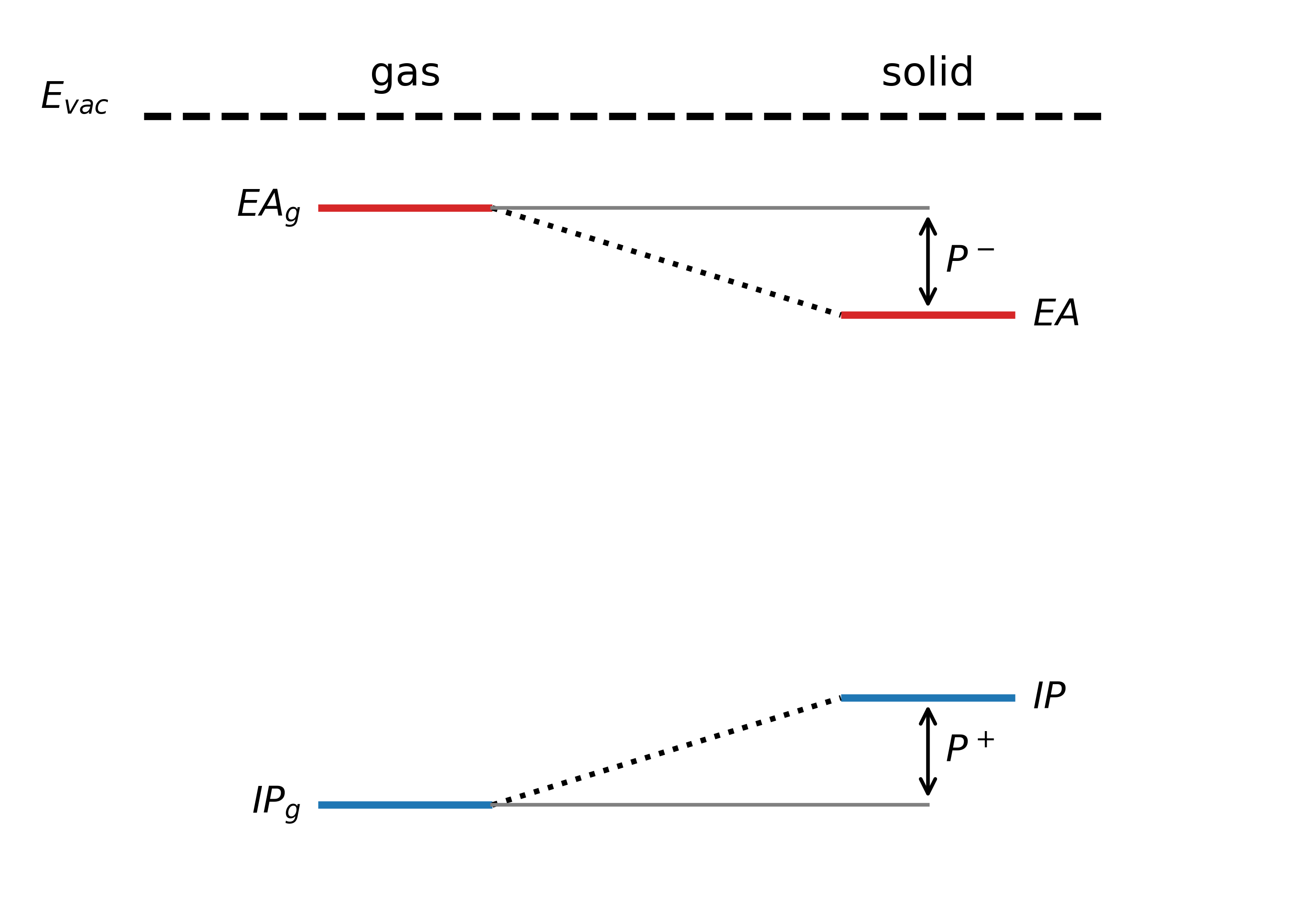
Various theoretical methods exist to compute solid-state \(IP\) and \(EA\) [1], most accurate of which relying on the separate treatment of the molecule of interest which is treated with the as accurate as possible quantum-chemistry method (normally GW), while employing various approximations for its interaction with the environmental molecules, recognizing dominate electrostatic nature of intermolecular interactions. The fastest method to estimate \(IP\) and \(EA\) is however to use the implicit solvent model like COSMO to capture the essential induced polarization response and some high-level quantum chemistry method like GW to evaluate the gas-phase \(IP\)/\(EA\) (see IP/EA Estimator).